It takes the place of the cover.
The kit follows the shape and the seven bolts of the stock ignition cover. The original stator moves into the new cover, in the same position.

TITAN is a centrifugal supercharger kit for the KTM 450 SX-F. It takes the place of the ignition cover, is driven by the crankshaft and pushes more air into the cylinder. It’s a project in development: here we show you the concept, the calculations and the first 3D model.
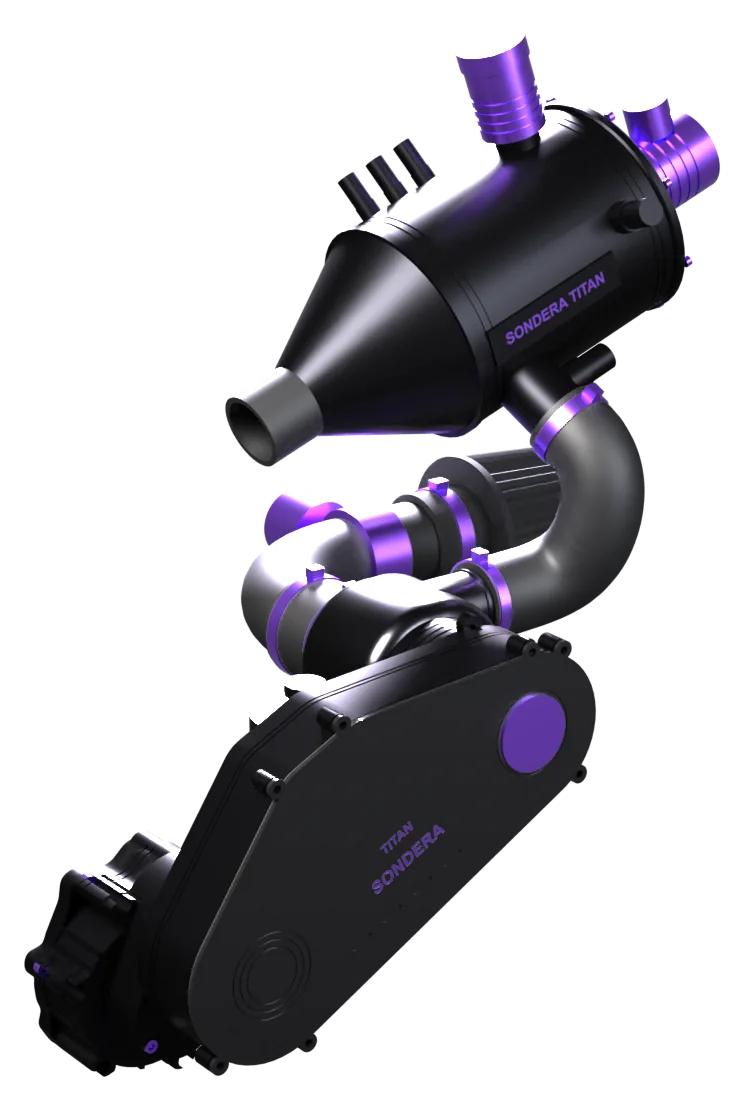
Supercharging a motocross single usually means opening up the engine. TITAN starts from a different idea: a single assembly that fits in place of the ignition cover and comes off whenever you want.
The kit follows the shape and the seven bolts of the stock ignition cover. The original stator moves into the new cover, in the same position.
A pair of gears and a belt carry drive from the crankshaft to the supercharger. The higher you rev, the more air reaches the cylinder.
No machining on the engine. Refit the original cover and the bike is back to stock.
Where are we? Calculations, 3D model and electronic board are done. The first physical prototype and the dyno tests are still to come.
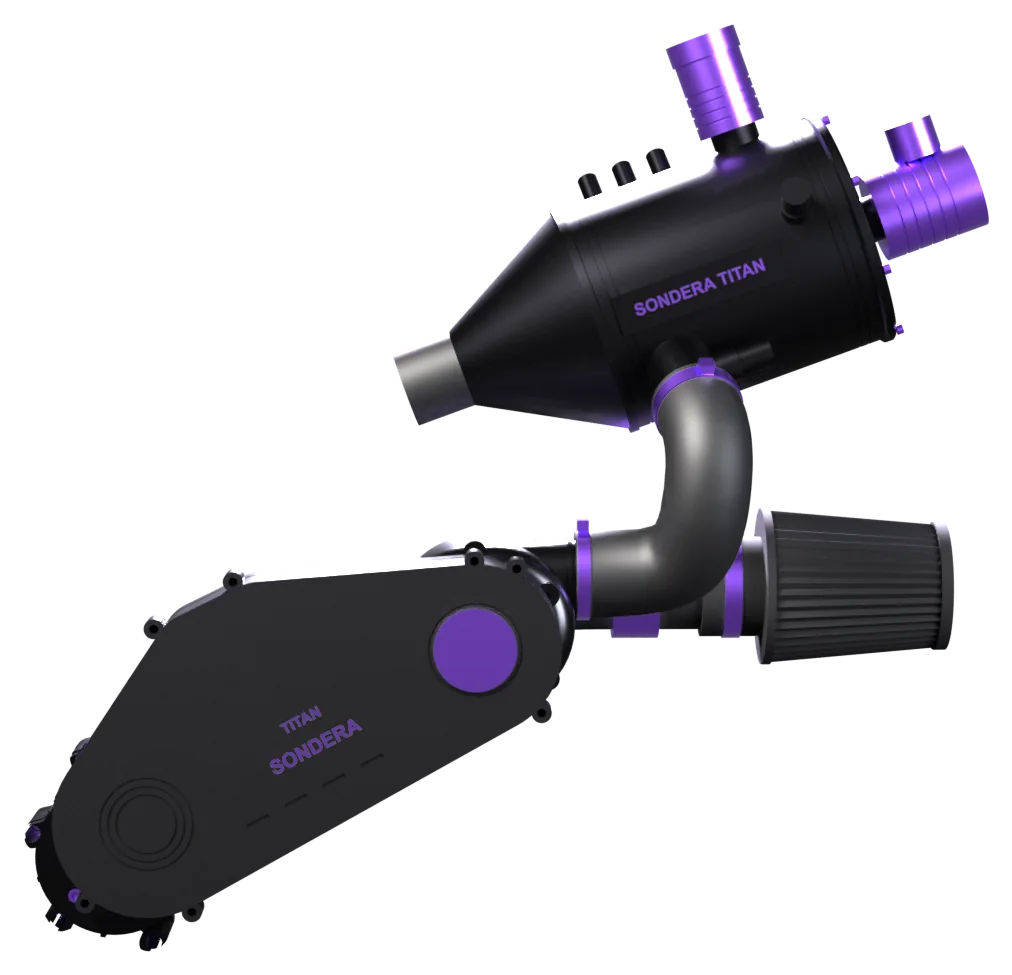
The billet aluminium cover follows the outline of the original and widens outwards. Inside are the gears, running in engine oil; outside is the belt housing, closed by a small gasketed cover against mud and water.
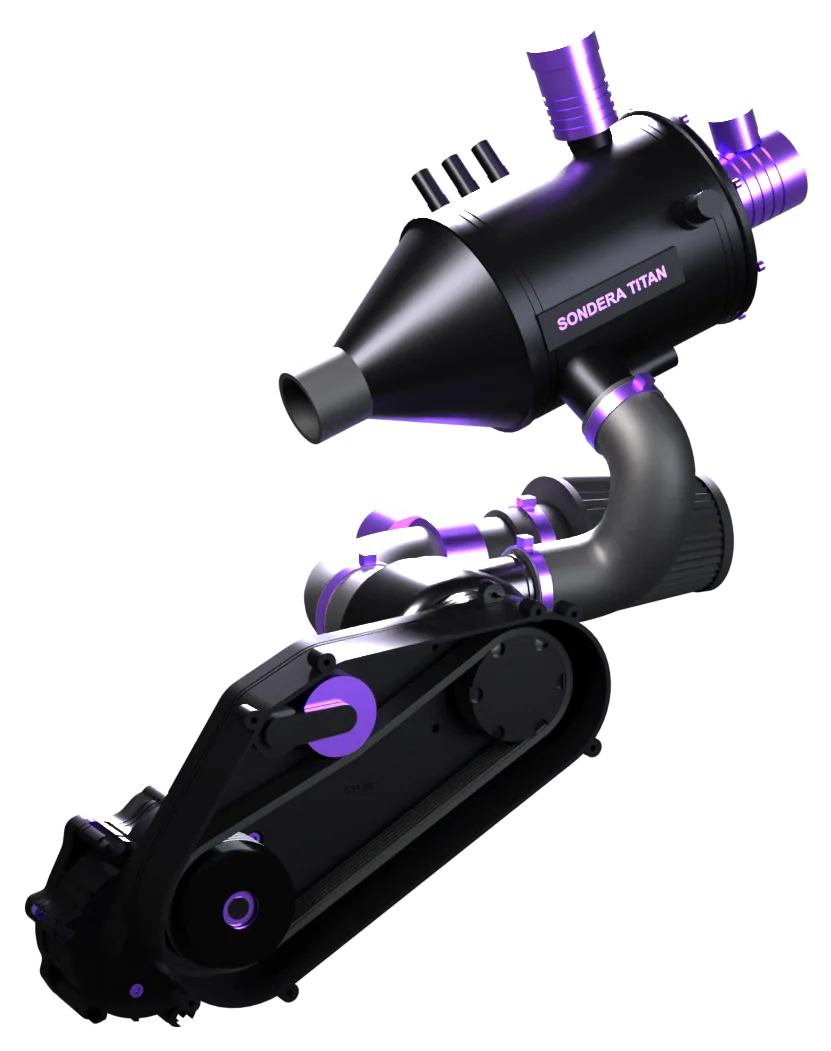
A single-cylinder engine runs in pulses. That’s why the drive pulley has a spring and a freewheel that absorb the shocks: in our calculations the peak torque on the belt drops from about 48 Nm to less than 3 Nm.
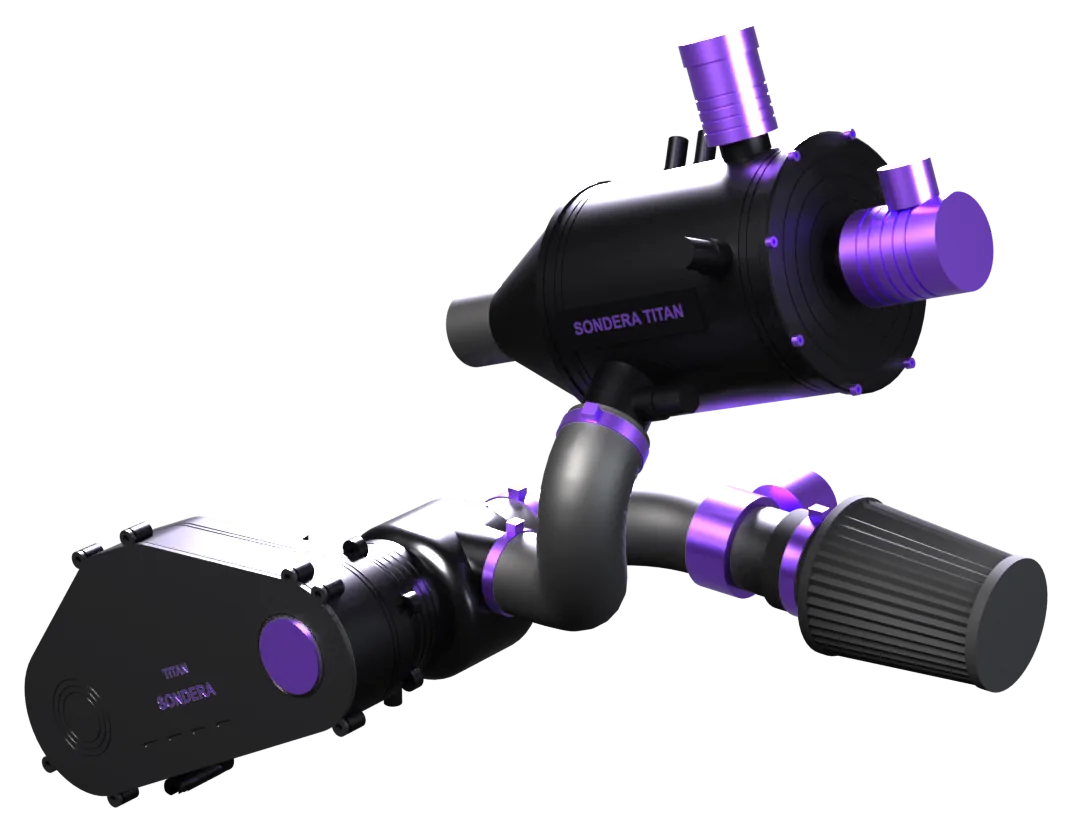
The compressed air passes through a plenum that damps the single’s pulses and reaches the stock throttle body. A calibrated mechanical valve vents excess pressure, even with the electronics off.
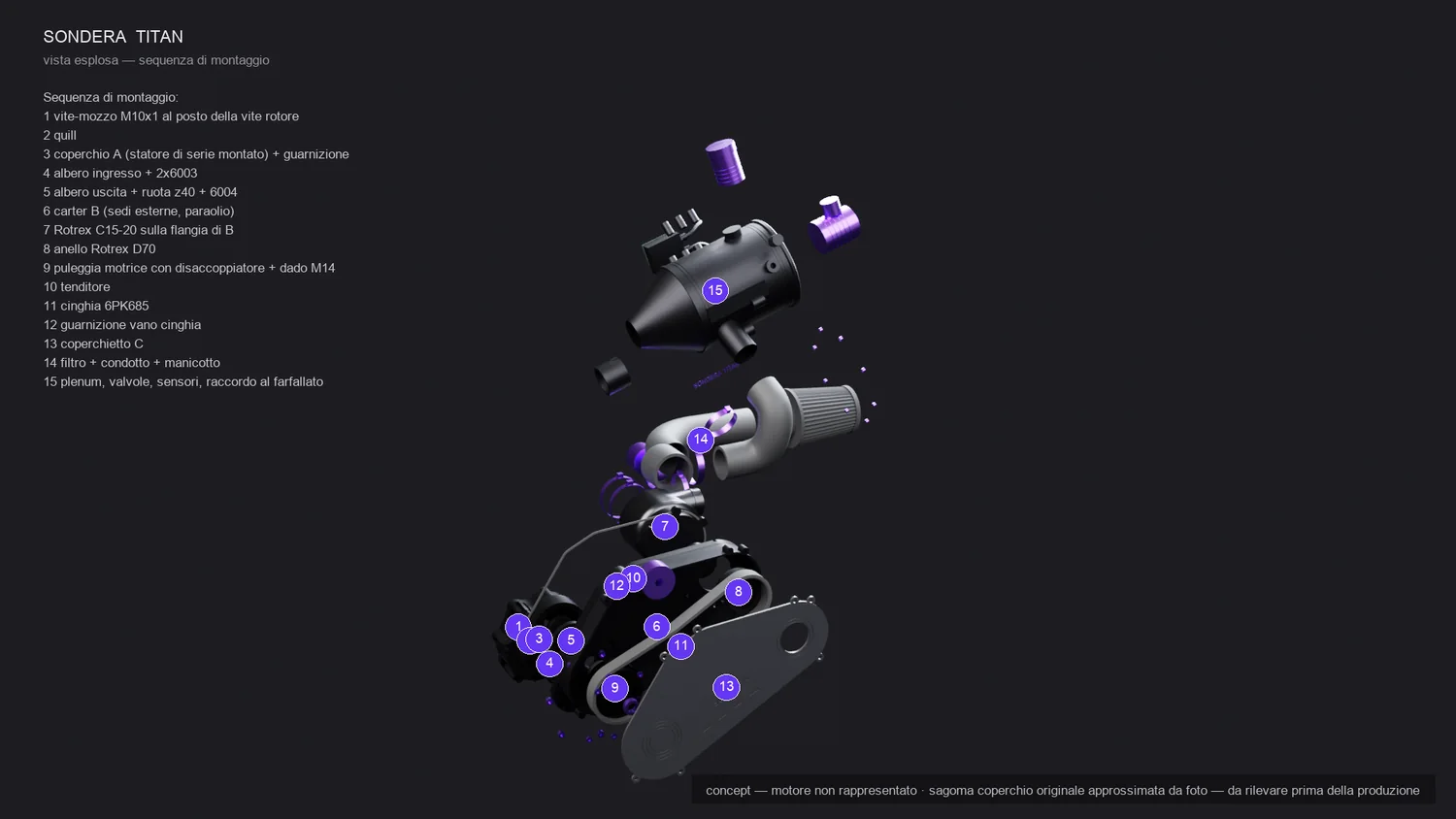
Every part has its place in the assembly sequence: hub on the crankshaft, cover with the stator, gears, supercharger, belt, small cover, ducts and plenum.
These are renders of the 3D model. The shape of the stock cover is derived from photos and has to be measured on the real part before production: the final kit may change.
These numbers come from our simulator, calibrated on dyno tests of the stock bike published by the press. They are not measurements: the light band in the charts shows how far they can move.
Drain the oil, unplug the stator connector and undo the seven bolts of the ignition cover.
The stock stator goes into the new cover. On the crankshaft, the kit’s hub takes the place of the rotor bolt.
Cover with a new gasket, gears, supercharger, pulleys, belt and small cover.
Filter, ducts and plenum up to the throttle body. Then sensors, control board and ECU.
A programmable ECU is required. The stock one doesn’t know it has a supercharger: fuelling and ignition timing must be recalibrated on the dyno.
It isn’t for sale and doesn’t have a price yet. Leave us your email: we’ll write to you when the prototype runs on the dyno and when we publish the first measurements.
It’s a forced-induction kit for the KTM 450 SX-F: a centrifugal supercharger driven by the crankshaft that sends more air to the cylinder. It fits in place of the ignition cover.
No. TITAN is a concept with a first 3D model and the design calculations. It has no price and is not for sale: you can join the waiting list to follow its development.
Our estimates point to about 17% more peak power at the wheel, with a margin between 6 and 24%. These are calculations, not measurements: the real values will come from the dyno.
No. You remove the ignition cover, move the stator into the new cover and fit the assembly. The crankcases are not machined and the installation is reversible.
We don’t know yet, and it’s the most important question of the project. The engine has a high compression ratio and the limit is knock. We’ll measure it on the dyno in small steps, before claiming any pressure.
Yes, you need a programmable ECU and a dyno calibration of fuelling and ignition timing. The stock one doesn’t account for the supercharger’s pressure.
No. The FIM motocross technical regulations ban forced induction, and the kit is not homologated for road use. It’s designed for the dyno and private tracks.
A small board reads pressure, temperatures and revs and sends them to the app via Bluetooth, where you see them with V.E.G.A. Overpressure protection does not depend on the app: it relies on a mechanical valve and a separate circuit.
An open project, told with real numbers: the ones we calculate today and the ones we’ll measure tomorrow.